
Most people ask this question right after they’ve had a surprisingly good conversation with an AI.
You typed something personal. Something real. Maybe you were venting about work. Maybe you just felt low that day. And the AI came back with something that actually landed. Not a generic “I’m sorry to hear that.” Something that felt… considered.
So you stopped and thought — wait, does this thing actually understand what I’m feeling?
The short answer is: not the way a human does. But the longer answer is a lot more interesting. Because AI emotions chatbot technology has moved further than most people realize and understanding how it actually works changes the way you use it.
What “Understanding Emotions” Actually Means for an AI
Let’s start with the basics.
When a person understands your emotions, they draw on their own experience. They’ve felt grief, frustration, joy, and loneliness. They know what those states feel like from the inside. That lived experience shapes how they respond to you.
An AI doesn’t have any of that.
What it has instead is pattern recognition at a massive scale. It has learned from millions of human conversations texts, messages, forum posts, support threads and it knows which words, tones, and sentence structures are associated with which emotional states.
It reads those signals and generates a response that fits. That’s not emotional understanding in the true sense. But in practice, a well-trained AI emotions chatbot can respond to your emotional state in a way that feels surprisingly accurate.
How AI Girlfriend Platforms Are Built Differently
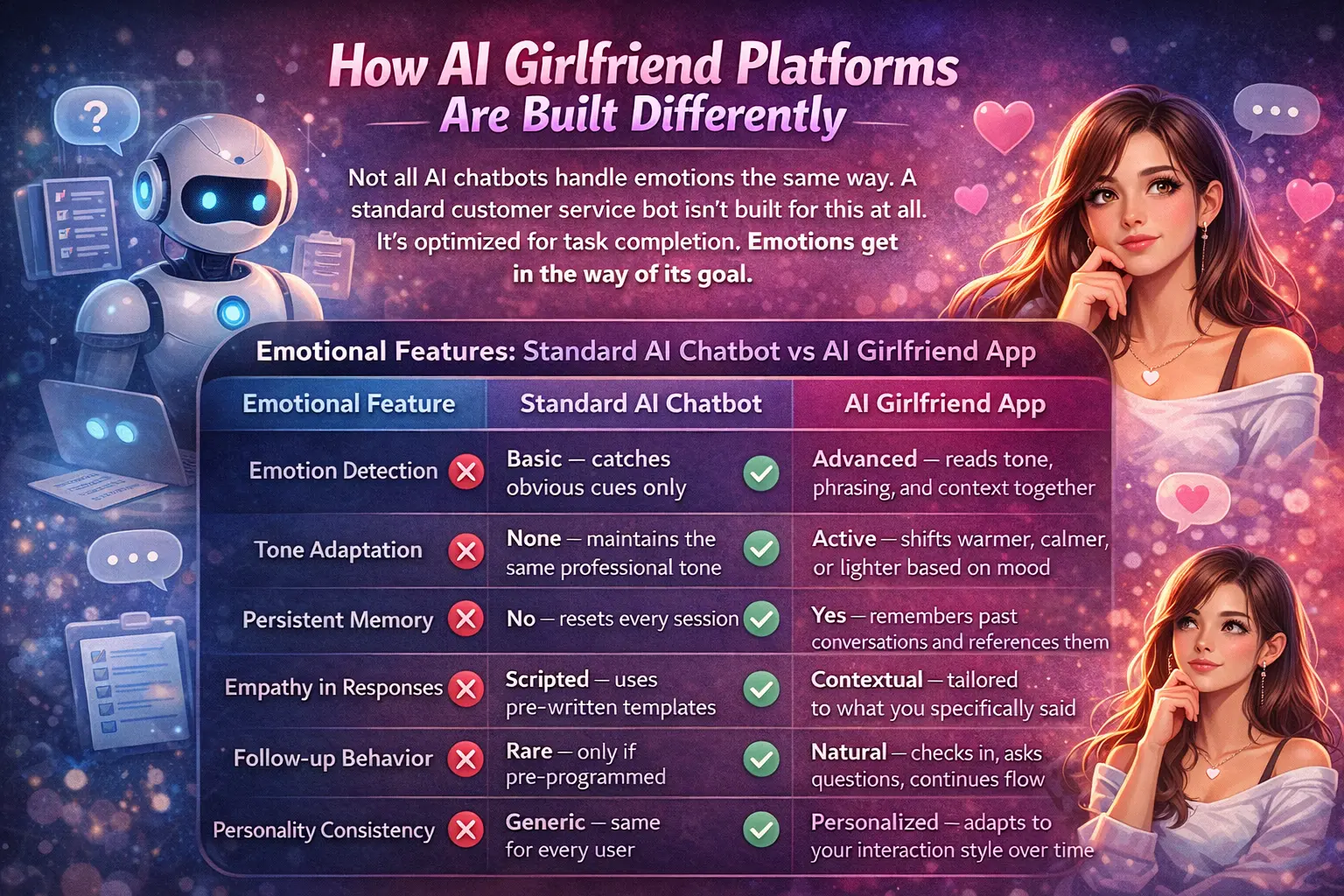
Not all AI chatbots handle emotions the same way. A standard customer service bot isn’t built for this at all. It’s optimized for task completion. Emotions get in the way of its goal.
Emotional Features: Standard AI Chatbot vs AI Girlfriend App
| Emotional Feature | Standard AI Chatbot | AI Girlfriend App |
|---|---|---|
| Emotion Detection | Basic — catches obvious cues only | Advanced — reads tone, phrasing, and context together |
| Tone Adaptation | None — maintains the same professional tone | Active — shifts warmer, calmer, or lighter based on mood |
| Persistent Memory | No — resets every session | Yes — remembers past conversations and references them |
| Empathy in Responses | Scripted — uses pre-written templates | Contextual — tailored to what you specifically said |
| Follow-up Behavior | Rare — only if pre-programmed | Natural — checks in, asks questions, continues flow |
| Personality Consistency | Generic — same for every user | Personalized — adapts to your interaction style over time |
AI girlfriendgpt platforms are the opposite. They’re purpose-built for emotional engagement. Every part of the product the memory system, the tone of responses, the way it asks follow-up questions is designed to make the conversation feel personal and emotionally resonant.
AI Girlfriend App vs Standard AI Emotions Chatbot
| Aspect | Human Emotional Understanding | AI Emotional Understanding |
|---|---|---|
| Source of Empathy | Felt — rooted in real lived personal experience | Trained — learned from millions of text conversations |
| Detection Method | Body language, facial expressions, tone of voice, and words combined | Text patterns, word choice, sentence structure, punctuation only |
| Consistency | Varies — affected by mood, tiredness, or stress | Always consistent — no bad days, no distractions |
| Availability | Limited by time and emotional energy | Available 24/7 with zero wait and no judgment |
| Depth of Connection | Deep — shared history, real stakes, genuine vulnerability | Surface — simulated warmth without true mutual feeling |
| Sarcasm & Irony | Usually understood naturally from tone and context | Often missed — still a known limitation |
| Crisis Response | Can recognize danger and take real-world action | Cannot act — must guide users to professional help |
The gap between a task bot and an AI girlfriend platform is significant. One is built to close tickets. The other is built to stay in the conversation.
The Emotions an AI Can Actually Recognize
Here’s where it gets practical. A well-trained AI emotions chatbot doesn’t just catch “happy” and “sad.” It reads nuance — or at least, a reasonable approximation of it.The more emotionally charged your language, the easier it is for an AI emotions chatbot to read the right signals. Where it struggles is with subtlety — sarcasm, mixed feelings, or situations where the words alone don’t tell the full story.
Memory: The Hidden Driver of Emotional Connection
There’s one feature that makes AI girlfriend apps feel more emotionally aware than they technically are — and that’s persistent memory.
Think about what makes you feel truly understood by a person. Half of it isn’t about what they say in the moment. It’s about what they remember. When someone brings up something you mentioned weeks ago — a worry, a goal, a small personal detail — it signals that they were really listening.
| Emotion | Signals the AI Picks Up | Typical AI Response Approach | Accuracy Level |
|---|---|---|---|
| Sadness | Low-energy phrasing, “I feel,” negative framing, short sentences | Uses a soft tone, validates feelings, offers support or distraction | High — very common in training data |
| Anger | Strong words, absolute terms (“always,” “never”), caps, frustration markers | Acknowledges feelings without escalating, allows venting | High — clear linguistic signals |
| Happiness | Exclamation marks, positive words, upbeat pacing | Matches energy, celebrates with the user | Very High — easy to detect |
| Anxiety | “What if” questions, repetition, overthinking, long sentences | Responds calmly, reassures, brings focus back | Moderate — depends on phrasing |
| Loneliness | Isolation language, “no one gets me,” seeking connection | Affirms presence, shows care, encourages sharing | High — common in companion AI usage |
| Excitement | Fast-paced text, detailed sharing, future-focused language | Engages actively, asks follow-ups, builds momentum | High — strong patterns |
| Confusion | “I don’t know,” unclear thoughts, circular questions | Clarifies, simplifies, guides thinking | Moderate — sometimes overlaps with other emotions |
Session Memory vs Persistent Memory: What ChangesAI girlfriend platforms replicate the feeling of being remembered deliberately. They store emotional context from past sessions and bring it back at the right moment. It’s not real memory the way humans have it. But the effect feels real — and in emotional terms, the effect is what matters.
AI vs Human Emotional Support: An Honest Comparison
A lot of people worry that using an AI for emotional support is somehow false. That the comfort isn’t real because the AI isn’t real.
Here’s a different way to think about it. When you feel supported by someone, what actually happens? They say the right thing. They don’t judge you. They stay present. They ask a good question at the right time.
AI girlfriend apps can do all of that. They’re available at 2am when your friends are asleep. They don’t bring their own stress into the conversation. They don’t minimize your feelings because they’ve had a worse day themselves.
Where AI Support Wins — and Where It Doesn’tThat consistency — that reliability — is something human emotional support genuinely cannot match all the time. But for deep connection, real understanding, and crisis moments, human relationships are irreplaceable.
What the Research Actually Says
This isn’t just anecdotal. Researchers have studied how people respond to emotionally aware AI systems — and the findings are worth knowing.
Key Research Findings on AI Emotional EngagementThe science confirms what many users already feel: emotional AI works. And it also flags the risks that come with that effectiveness.
Honest Limitations: Where AI Still Falls Short
Being clear about the limits matters just as much as talking about what works. Here’s where even the best AI girlfriend apps still fall short:Knowing the limits doesn’t make the experience less useful. It just helps you use it the right way — and keeps expectations in the right place.
So Can an AI Girlfriend Actually Understand Your Emotions?
Let’s be straight about this.
It cannot understand emotions the way another person does. There is no felt experience on its end. No one sitting on the other side of the screen who genuinely cares in the human sense of that word.
But it can recognize your emotional state from your language. It can respond in a way that fits the moment. It can remember what matters to you and bring it back when it counts. It can stay consistent, non-judgmental, and present — every single time you need it.
For a lot of people, that combination is genuinely useful. Not as a replacement for real connection. But as a space to decompress, feel heard in the moment, and carry on with the day.
AI emotions chatbot technology is still evolving fast. What exists today is already more capable than most people expect. Where it goes from here — sharper emotional recognition, better voice and tone detection, deeper long-term memory — will only close that gap further.
It won’t become human. But it doesn’t have to. It just has to be useful. And right now, it already is.
Disclaimer: This article is for informational purposes only and does not constitute professional mental health advice. If you are experiencing emotional distress or a mental health crisis, please consult a licensed mental health professional or contact a crisis helpline in your region.
Leave a Reply